
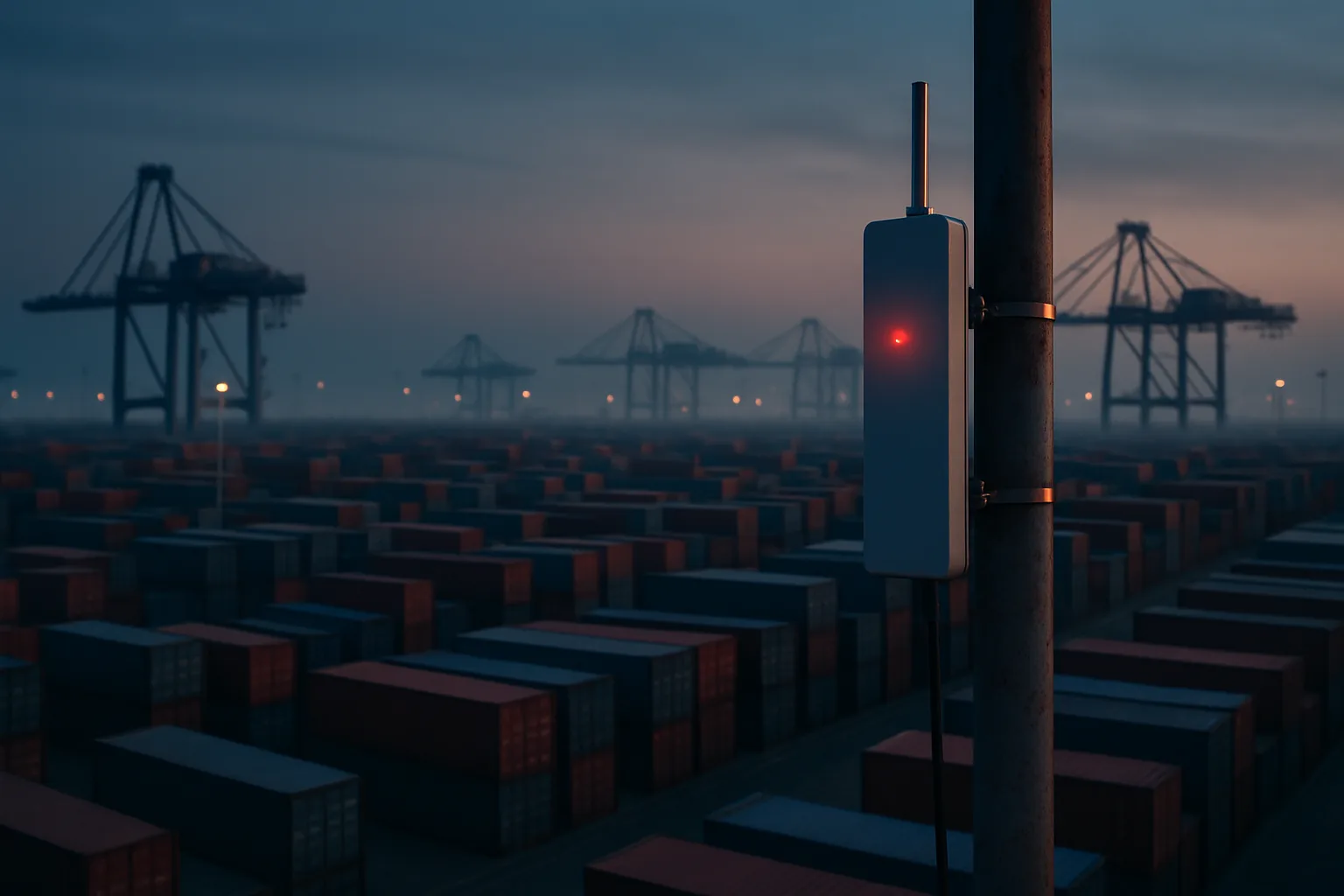
A working port is one of the most hostile radio environments on earth. Thousands of steel boxes stacked nine high, rearranged hour by hour. Cranes and reach stackers in constant motion. Salt air corroding everything. And a footprint measured in hundreds of acres, most of it outdoors where there's nothing to mount a radio on.
This customer had tried the obvious things. Carrier coverage dropped to nothing between the container stacks. Wi-Fi worked in the admin building and died fifty feet past the door. Handhelds in the yard fell back to writing things on paper and keying them in later — which is exactly the kind of gap that loses a container.
What we got wrong on the first pass
Our first coverage plan treated the yard like a flat field. Put up a few sectors, model the propagation, done. That model was useless the moment the stacks went up. A wall of containers is effectively a moving building — coverage you validated on Tuesday is gone on Thursday when the stacks reorganize.
The lesson: in a container environment you design for the worst-case stack configuration, not the average one, and you accept more overlap than feels efficient. The redundancy is the point. When one path is blocked by a fresh wall of steel, the device finds another.
What actually worked
- Height and overlap. Mounting sectors high on existing light poles and crane structures, with deliberate overlap, gave devices multiple paths into the stacks. Fewer, taller, overlapping beats many, low, and isolated.
- CBRS instead of Wi-Fi. Private LTE on the 3.5 GHz band carried far better through and around the steel than 5 GHz Wi-Fi ever could, and it held the connection as equipment moved at speed.
- Priority that matters. Because it's a private network, we put crane telemetry and safety traffic ahead of everything else. A video upload waits; a stop command does not.
- SIMs, not a forklift upgrade. The existing rugged handhelds and vehicle-mounted units already spoke cellular. We issued SIMs and provisioned them — no new fleet.
The number that mattered
The customer didn't care about RSRP maps. They cared about one thing: could a driver in the far corner of the yard scan a container and have it confirm, every time, without walking back toward the building. After the redesign, that worked across the whole footprint — including the spots that had been dead for years.
That's the real takeaway from a port deployment. The physics are brutal, but they're solvable with the right tool and a coverage plan that respects how the site actually behaves. Wi-Fi was being asked to be something it isn't. Private cellular was built for exactly this.